
Everyone is downstream
By Burney Fischer - For the Park Rapids Enterprise
(Reprinted by permission of the Park Rapids Enterprise)
Here in lakes country, a broad but often under-appreciated role is that of an individual lake within the context of a much larger watershed.
Watersheds contain all kinds of land types – forests, wetlands, farmlands and even residential communities.
They also involve diverse types of landowners, including federal (national forests), state (forests and wildlife management areas), county (managed forestland, wetlands, etc.) and private lands, with similar or different uses. The management of these lands often requires the interaction of public/private interests with federal and state agencies, county and township governing bodies.
For example, Big Mantrap Lake in Hubbard County has its own watershed, which encompasses the land area surrounding any creeks or rivers that bring water into the lake. Beyond that, Big Mantrap is part of the broader Big Sand Lake Watershed, which is part of the larger Crow Wing River Watershed, which is part of the even larger Upper Mississippi River Watershed.
As these watersheds go beyond county lines, and even state boundaries, they are influenced by state and federal agencies and cooperating nonprofits (land trusts, etc.). As with watersheds, the governance is also hierarchical and cooperative, with the Big Mantrap Lake Association being part of the county level Hubbard County Coalition of Lake Associations (COLA) that collaborates with all kinds of government and non-government partners.
Big Mantrap and all Hubbard County lakes have gone through a similar history.
Timber was harvested and some of the land was cleared for agriculture. Lake resorts were the first residents on many lakes. Later, the lake shoreline was divided into individual parcels and sold for summer cabins. Towns serving the early industries eventually evolved to focus on tourism. The governing structure of the lakes started to emerge in the 1950s with small neighborhoods on lakes joining together to form the earliest lake associations.
In 1988, the COLA formed and its membership now involves 32 lake associations. While townships play a role, it is the county that has really become a governing leader, with the development of such things as shoreline ordinances, aquatic invasive species inspection at public accesses, the monitoring and required upgrading of septic systems in the 1990s, the management of county lands and many other initiatives.
The Minnesota Department of Natural Resources divisions of forestry (Paul Bunyan State Forest), wildlife (wildlife management areas), fisheries (regulations, monitoring, and stocking programs) and ecological and water resources (water quality monitoring, etc.) provide a state focus and interact with the county. Overall, there are lots of points of leadership with no one governing body solely in charge.
As an individual lake’s health depends on various activities going on in the surrounding watershed, similarly, the various levels of government work together to maintain a safe and prosperous setting for individual lakes.
The whole lake watershed storyline is best captured by the often-used phrase “Everyone is downstream,” which is an ecological and ethical concept emphasizing that all actions taken upstream affect everyone downstream. My conclusion is that understanding lakes from the smallest to the broadest perspective is important, and it is not just from an ecological or environmental perspective, but also from a governance perspective.
In nature, when things are interacting effectively for the overall good of the system, things function well. And, when various levels of governance work together harmonically there is a similar positive result.
Burney Fischer, clinical professor emeritus at Indiana University’s O’Neill School of Public and Environmental Affairs, is a member of the Big Mantrap Lake Association.
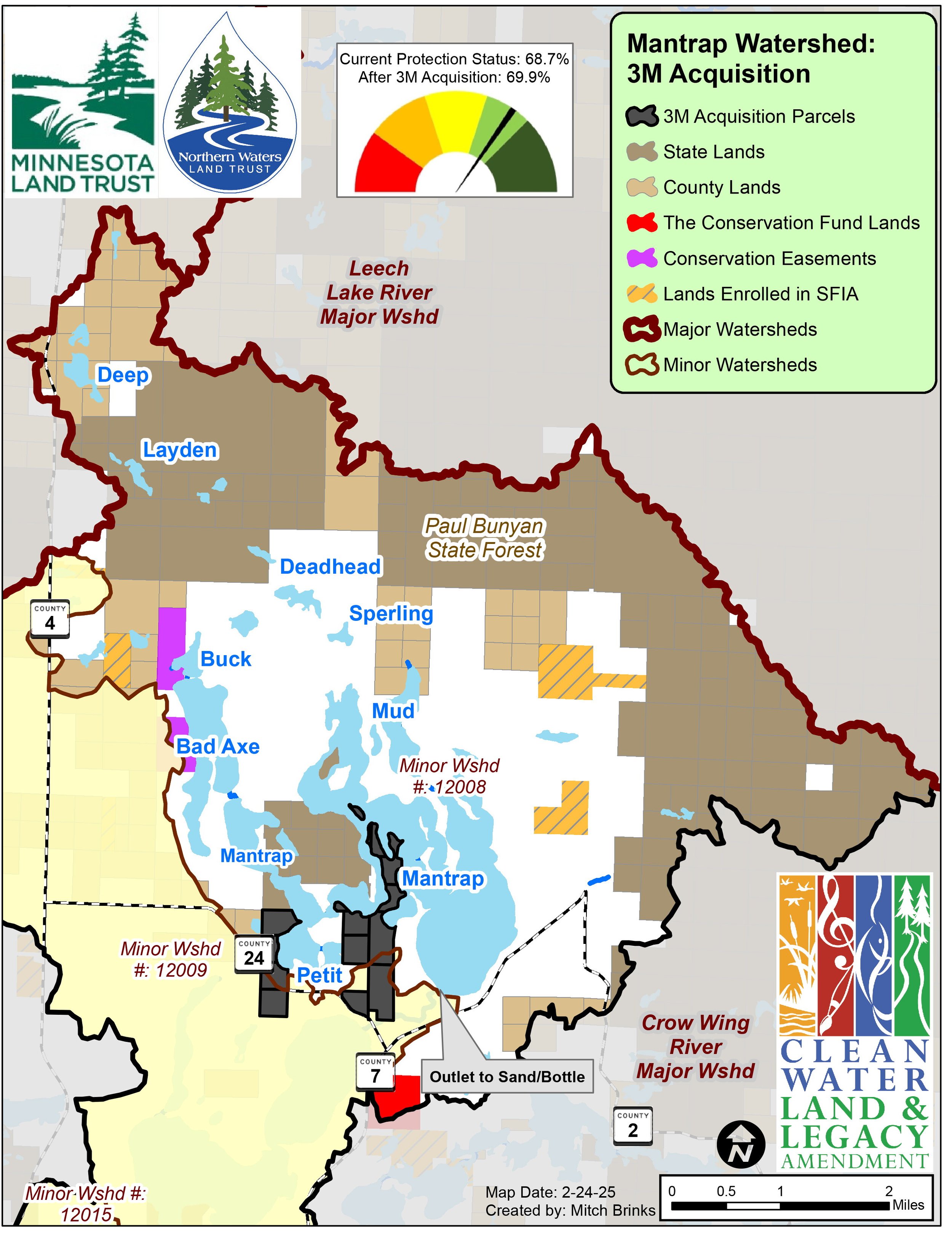
Watershed map. Contributed by the Minnesota Land Trust and Northern Waters Land Trust.